
Thank you Maria Claughton for allowing us to repost this from October 2023
Just when we thought we’d hung up our wetsuits and snorkel gear for the season, along came a July-like afternoon at the start of the October mini heatwave: Friday 6th October to be precise. Ultra-low wind promised an opportunity too good to pass up, so John and I headed off to Boat Cove to conduct what we expected to be our final Seasearch snorkel of the season. Even before we got in, we knew we had spotted something really cool! Pushed in by the incoming tide, and steadily approaching the shallows on a super-calm sea – the unmistakable large translucent pink and purple crimped float and long indigo blue tentacles of a Portuguese Man O’ War!
Native and common on the Atlantic, Pacific and Indian Oceans, these rarely turn up on UK shores. And, where they do, they’re blown in off the open ocean by westerlies, usually in Cornwall or the Isles of Scilly, with others on the West Coast of the UK, mostly in North Wales. On the day that we had our exciting find, we’d checked online about how poisonous they were, only to find that, on the previous day, a few had washed up on a beach we know in Anglesey and had made the BBC Science headlines!
When John and I saw ours, it was easy to see why, with its tentacles and its colourful float, many people are led to assume that the Portuguese Man O’ War (Physalia physalis) is a jellyfish, but it is, in fact, a siphonophore – a colonial hydrozoan. It is also not an ‘it‘ but, rather, a ‘they‘! It’s a creature that is actually made of four organisms, each made up of a community of individual creatures called ‘zooids’, functioning and operating as a single animal.
Each zooid cannot live independently and belongs to one of 4 main ‘departments’ in the animal, dedicating itself to one specific function, for instance, the ‘gonozooids’ focus on reproduction, whereas the other three take care of keeping afloat, capturing prey & defending and feeding. The floating ‘department’ generates the gas-filled bladder or ‘pneumatophore’ (which can reach 30cm in length) and this acts as a sail to be blown wherever the winds will take it! Surprisingly, the pneumatophore can also be temporarily deflated if the creature is threatened. This causes the creature to sink below the water. Unlike a jellyfish, a Portuguese Man O’ War cannot propel itself but, like a jellyfish, it is a formidable predator, capable of catching 100 small crustaceans and fish a day with its long retractable stinging tentacles. These are made of ‘gastrozooids’ (for feeding) and ‘dactylozooids’ (for capturing prey and defence).
These tentacles (which reach 10 – 30 metres in length) must be avoided by humans as they deliver an excruciatingly painful sting that, in very rare cases, has even been fatal! The advice is to not touch the creature at all and, what’s more, the Man O’ War remains highly venomous, even weeks after it has died!
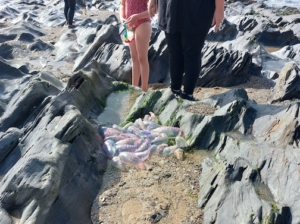
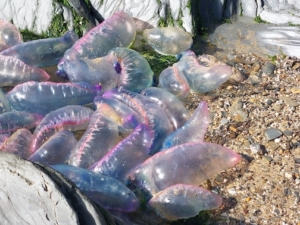
Clearly somebody had touched a number of these creatures the next day (on 7th October) when, in Dollar Cove, round on the Lizard Peninsula, John and I were met with this sight in one of the rockpools! Someone had rounded them up from the beach. Despite this, dozens of them were still randomly stranded on weed and in rockpools the entire length of the beach at the strandline.
The unseasonably hot weather and a weekend had brought many people out to the beach. The large ‘collection’ in the rockpool attracted a steady flow of spectators who were as surprised as we were to observe that the pointed ends of many of the pretty floats were sporadically twitching and twisting upwards! John and I were actively persuading the many onlookers at the rockpool (amongst them young children) not to touch any part of these very colourful, yet poisonous, curiosities, and to pass on this advice.
The vast majority of those who stopped with us to look at the pinky-purple alien-looking gaggle asked us what they were? The next most popular question was why were they called a Portuguese Man O’ War? I explained that they were named for the similarity that the shape of the float has to that of the ‘morion’ helmet, topped with its inverted crescent-shaped comb, that was worn by the Portuguese and Spanish conquistadors – the well-armed explorers and naval foot soldiers of the 16th century. As with many names, its origin gets disputed. Others say that the Portuguese Man O’ War resembles a wooden sailing ship, at full sail, of the type used by the Portuguese navy in the 15th and 16th centuries. So, who knows?!
But one sure thing is that these highly-venomous creatures, that are common out on the open ocean, do not reign supreme. The Portuguese Man O’ War does have predators of its own! It becomes food for a number of marine creatures that are adapted to hunt the Portuguese Man O’ War without getting poisoned themselves. Amongst these are the Loggerhead Turtle, the Ocean Sunfish and the Blanket Octopus. Portuguese Man O’ War are also the favourite food of the Violet Sea Snail. This is an equally weird organism – a sea snail that hunts its prey on the sea surface where it remains thanks to an ingenious bubble raft that it builds itself! There’s even the small Blue Glaucus Nudibranch (Glaucus atlanticus), sometimes called the ‘Blue Sea Dragon’, that brazenly feeds on the Portuguese Man O’ War, ingests the venomous stinging nematocysts and stores them in its own tissues to serve as defence against its own predators!
Well, look out for these rare visitors when they next blow in again! And, if you do find a Portuguese Man O’ War or 30 (!), blown in and stranded, please remember that this is considered a marine stranding and should be reported to the Cornwall Wildlife Trust Marine Strandings Hotline (0345 201 2626)!


