
As we arrived at the rocky cove for my planned swim workout, it was clear that the weather forecast had got it very wrong! But it was still healthy and bracing in its own way just being on the pebbly beach, out of the worst of the wind, watching the Little Egrets chopstick through the wet kelp along the strandline, interrupted only by the boisterous arrival of a small group of Turnstones that flew across the breaking waves and bundled in on the elegant white herons like a bunch of excitable junior school children.
Hunkered down myself in a fleece, walking trousers and hiking boots, I watched the waves pounding in onto the rocky shore, parcelling up the long kelp fronds into long rolls – slick and shining with seawater – all the time keeping them rotating like the brown leathery blade cylinders of a combine harvester.
Quite the congregation of gulls – predominantly Black-headed, with the odd Herring and Great Black-backed Gull thrown in – was afloat in the cup of the cove, picking noisily at passing morsels on the surface.
We’d already opted for “plan B” – pitching our camp much higher up the shore than “plan A” – and were happily sheltered from the stiff breeze by the sandstone bank of tamarisks.
With each wave break, and with the wind increasing as though to lend the required energy to push the kelp roll up the steep beach shelf that it now met at the shoreline, the glistening brown turbine moved steadily closer to the edge of our beach blanket. And then it happened!
As though a silent alarm had sounded, up and outwards burst the horde: charging ahead, “SAVE YOURSELVES!” they seemed to shout, tripping over themselves and one another in their great haste to reach higher ground. Literally dozens of Sea Slaters sprinting willy-nilly, racing to escape the incoming tide – their prehistoric armour lending them no defence against this heavy onslaught!
Sea Slaters do have gills but are only able to survive very brief periods underwater, drowning if fully submerged for too long. Face to face with your first Sea Slater, you could be forgiven for thinking you’d found a giant Woodlouse – as that’s pretty much what it is! It’s a crustacean growing to some 3cm in length, that can live for about 2½ years and belongs to the same order (Isopoda) as the Woodlouse. Fun Fact: the Sea Slater (Ligia oceania) is, in fact, classed as the UK’s largest Woodlouse!
It is not often encountered as it tends to move around under the cover of darkness in a very precise section of rocky shores – in the splash zone just above the high tide mark. During the day it hides away amongst wet stones, piles of damp seaweed and in deep crevices in rock. It must absolutely keep in contact with moist conditions, otherwise it will quickly perish. The reason for this is that its gills must always retain a thin film of water from which it is able to extract oxygen to breathe. For the very same reason, our familiar Woodlouse of the log pile, garden wall, leaf litter and compost heap, also has to actively frequent the dampest environment possible. If you were to flip a Woodlouse over and inspect its underparts, you would see that the last legless segments consist of a series of closely-fitting, thin flaps called “pleopods”. The pleopod membranes must be constantly coated in a thin film of water (and this is the definition of a “gill”) – else oxygen cannot pass across this from the air into the Woodlouse’s blood. Thus, terrestrial isopods still require gills to breathe!
Like Woodlice, Sea Slaters are classed as terrestrial isopods and, evolutionarily speaking, both species have only just left the sea where most of their crustacean relatives can still be found: the crabs, lobsters, prawns and shrimps. Their reliance upon gills is testament to this. Woodlice have evolved more than Sea Slaters to have become more adapted to living on land, so can tolerate slightly dry conditions when forced to.
However, Sea Slaters are not permitted this luxury. They have a particularly permeable skin, and gills that are less adapted to living on land than those of Woodlice. Their coastal cousins are under constant risk of dehydration by both sun, salt and wind and, at the other end of the scale, risk drowning by the incoming waves! In order to regulate their humidity and temperature Sea Slaters must control this by being prepared to move home often – striving to locate themselves in the section of the shore that offers them the optimum conditions.
Although home is an extremely narrow and hostile section of the shore, the Sea Slater is ideally suited to its environment. It presents itself as a tasty morsel to coastal wading birds and gulls. However, during daylight hours, provided it is not being made to race up the beach to avoid the waves, it will remain very still in relative safety for hours on end.
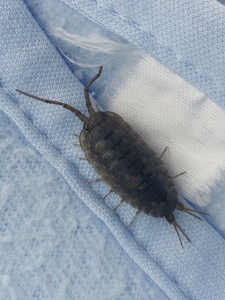
The Sea Slater’s chainmail armour tends to be one background colour – from a palette of yellow, green, brown or grey – sometimes adding speckles of black. But this is a fluid situation – for the Sea Slater is quite the chameleon! It has the superpower of possessing melanophores which, as in the cuttlefish, allows it to switch up the patterning and the pigment distribution in its cuticle to blend in with its micro-environment. It makes this colour change mainly in response to light levels – aided by what are, for its body size, very large eyes which are extremely sensitive – but the colour changes can also be in response to altered humidity or temperature too.
Its long antennae are another striking feature of the Sea Slater. Apart from their function as sensory organs, the creature’s antennae have also been found to have specialised pores that help it to absorb water, to achieve the hydration so critical to a marine crustacean. They are even involved in the organism’s respiration, playing a role in extracting oxygen from the air and water. As sensory organs, the antennae are key to the creature, whether detecting predators whilst hiding away during the day, or allowing it to locate food and physically navigate the rocky shore when out on its nocturnal manoeuvres.
This is when the Sea Slater proves its greatest value to the coastal ecosystem where, just like the Woodlouse, it performs a sterling job in Nature’s own daily beach clean team! Sea Slaters are detritivores and favour feeding on washed-up, decaying wrack, kelp and other brown seaweeds. They will also feed on moss and lichen higher up in the lithic zone, and even on dead animal matter that they encounter. Whatever they’re chewing up, they help to break down and increase its surface area, upon which, later, bacteria and other micro-organisms such as fungi, can get to work to achieve full decomposition. For this role, together with its cockroach-like speedy, agile scuttling on its 7 pairs of long legs, it is not surprising that the Sea Slater has earned itself the nickname “Sea Roach” – poor thing!
Maria Claughton

